— Epochs of Power
The story of Karnataka.
An interactive journey through time, mapping the rise of empires, the depth of our heritage, and the pulse of our modern innovation.
Ancient Roots
We trace the origins of Karnataka, exploring the Neolithic settlements and the dawn of civilization that laid the foundation for a vibrant, enduring state. The Halmidi inscription is the oldest known Kannada-language inscription in the Kadamba script. While estimates vary slightly, the inscription is often dated to between 450 CE – 500 CE. The inscription was discovered in 1936 by Dr. M. H. Krishna, the Director of Archaeology of the (princely) State of Mysore (present-day Karnataka region of India), in Halmidi, a village in the Hassan district. The original inscription is kept in the Office of the Director of Archaeology and Museums, Govt. of Karnataka, Mysore, and a fibreglass replica has been installed in Halmidi.

Ancient Roots
We trace the origins of Karnataka, exploring the Neolithic settlements and the dawn of civilization that laid the foundation for a vibrant, enduring state. The Halmidi inscription is the oldest known Kannada-language inscription in the Kadamba script. While estimates vary slightly, the inscription is often dated to between 450 CE – 500 CE. The inscription was discovered in 1936 by Dr. M. H. Krishna, the Director of Archaeology of the (princely) State of Mysore (present-day Karnataka region of India), in Halmidi, a village in the Hassan district. The original inscription is kept in the Office of the Director of Archaeology and Museums, Govt. of Karnataka, Mysore, and a fibreglass replica has been installed in Halmidi.
Imperial Rise
The Chalukyas of Badami, Kalyani, and the Rashtrakutas pioneered rock-cut architecture and structural temple building in Karnataka, transforming sandstone and basalt into timeless wonders. From the UNESCO World Heritage monuments at Pattadakal and Aihole to the magnificent Ellora caves, their master builders fused Dravidian and Nagara styles. This architectural brilliance laid the foundational aesthetics for the later medieval epochs, establishing Karnataka as an eternal cradle of supreme stonemasonry and sculptural mastery.

Imperial Rise
The Chalukyas of Badami, Kalyani, and the Rashtrakutas pioneered rock-cut architecture and structural temple building in Karnataka, transforming sandstone and basalt into timeless wonders. From the UNESCO World Heritage monuments at Pattadakal and Aihole to the magnificent Ellora caves, their master builders fused Dravidian and Nagara styles. This architectural brilliance laid the foundational aesthetics for the later medieval epochs, establishing Karnataka as an eternal cradle of supreme stonemasonry and sculptural mastery.
Vijayanagara Era
The Vijayanagara Empire, also known as the Karnāta Empire, was a late medieval Hindu empire that ruled much of southern India. It was established in 1336 by the brothers Harihara I and Bukka Raya I of the Sangama dynasty. The empire rose to prominence as a culmination of attempts by the southern powers to ward off Muslim invasions by the end of the 13th century. At its peak in the early 16th century under Krishnadevaraya, it subjugated almost all of Southern India's ruling dynasties and pushed the Deccan sultanates beyond the Tungabhadra‑Krishna River doab region, in addition to annexing the Gajapati Empire (Odisha) up to the Krishna River, becoming one of the most prominent states in India. The empire's territory covered most of the lands of the modern‑day Indian states of Karnataka, Andhra Pradesh, Tamil Nadu, Goa, southern Kerala and some parts of Telangana and Maharashtra.

Vijayanagara Era
The Vijayanagara Empire, also known as the Karnāta Empire, was a late medieval Hindu empire that ruled much of southern India. It was established in 1336 by the brothers Harihara I and Bukka Raya I of the Sangama dynasty. The empire rose to prominence as a culmination of attempts by the southern powers to ward off Muslim invasions by the end of the 13th century. At its peak in the early 16th century under Krishnadevaraya, it subjugated almost all of Southern India's ruling dynasties and pushed the Deccan sultanates beyond the Tungabhadra‑Krishna River doab region, in addition to annexing the Gajapati Empire (Odisha) up to the Krishna River, becoming one of the most prominent states in India. The empire's territory covered most of the lands of the modern‑day Indian states of Karnataka, Andhra Pradesh, Tamil Nadu, Goa, southern Kerala and some parts of Telangana and Maharashtra.
Wodeyar Legacy
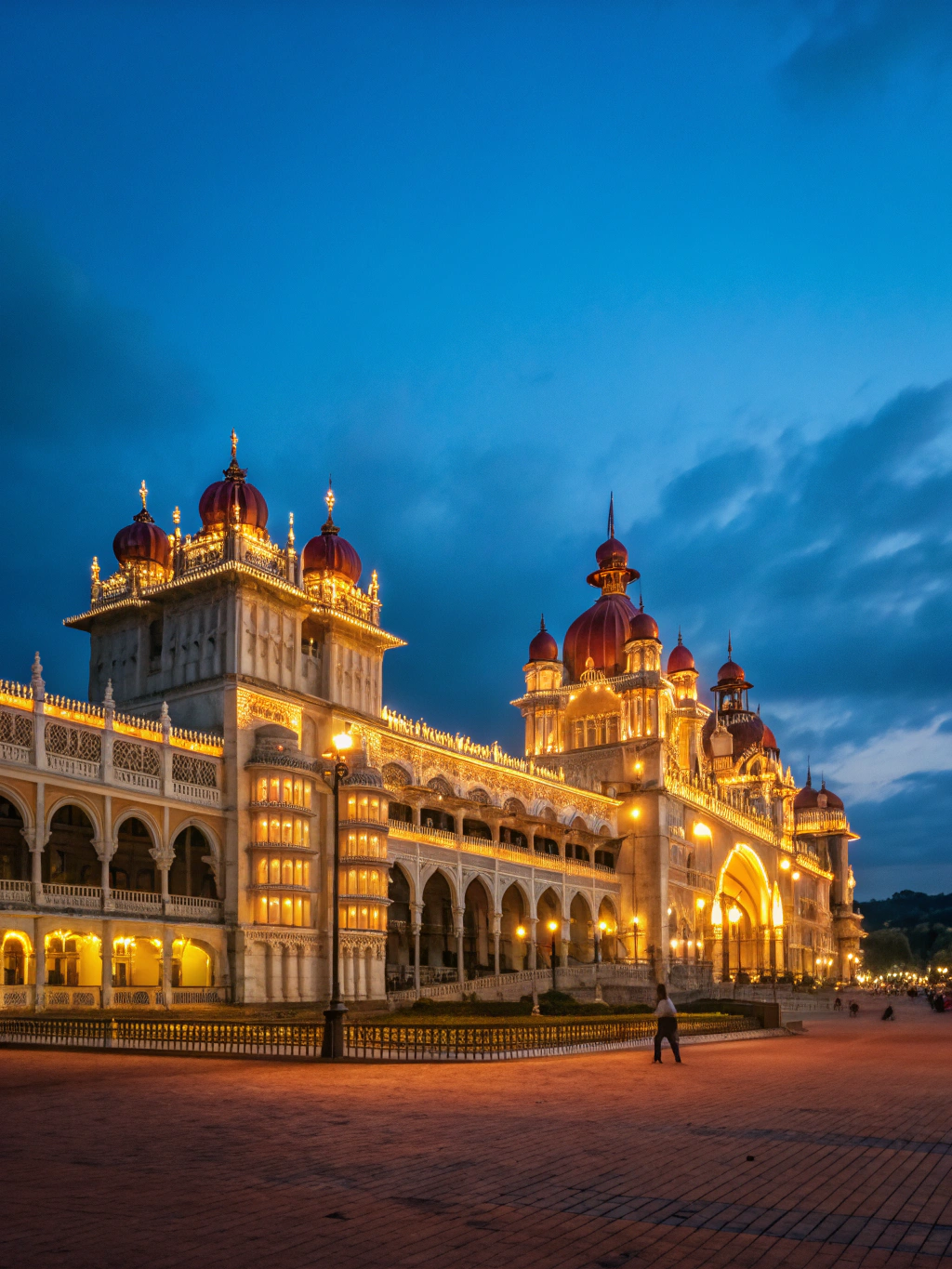
The Wodeyar dynasty, rulers of the Kingdom of Mysore from 1399 until Indian independence, left an indelible mark on Karnataka's history, culture, and governance. Under visionary rulers such as Maharaja Krishnaraja Wadiyar IV—hailed by Mahatma Gandhi as 'Rajarishi'—Mysore became a model state renowned for progressive social reforms, pioneering hydroelectric power at Sivasamudram, establishing the University of Mysore, and laying the groundwork for industrialization. Their unwavering patronage of Carnatic classical music, literature, fine arts, and the world-famous Dasara festivities cemented Mysore as the cultural heartland of modern Karnataka.
Wodeyar Legacy
The Wodeyar dynasty, rulers of the Kingdom of Mysore from 1399 until Indian independence, left an indelible mark on Karnataka's history, culture, and governance. Under visionary rulers such as Maharaja Krishnaraja Wadiyar IV—hailed by Mahatma Gandhi as 'Rajarishi'—Mysore became a model state renowned for progressive social reforms, pioneering hydroelectric power at Sivasamudram, establishing the University of Mysore, and laying the groundwork for industrialization. Their unwavering patronage of Carnatic classical music, literature, fine arts, and the world-famous Dasara festivities cemented Mysore as the cultural heartland of modern Karnataka.
Unification Path
Following the fall of Tipu Sultan in 1799 at the Siege of Srirangapatna, large parts of Karnataka came under British colonial rule, either directly under the Bombay and Madras Presidencies or indirectly through the Princely State of Mysore. This era witnessed profound administrative reorganization, the introduction of modern railways and telegraphs, and plantation economies, alongside growing nationalist resistance and the seeds of the unification movement.

Unification Path
Following the fall of Tipu Sultan in 1799 at the Siege of Srirangapatna, large parts of Karnataka came under British colonial rule, either directly under the Bombay and Madras Presidencies or indirectly through the Princely State of Mysore. This era witnessed profound administrative reorganization, the introduction of modern railways and telegraphs, and plantation economies, alongside growing nationalist resistance and the seeds of the unification movement.
Future Horizons
Today, Karnataka leads in technology and innovation, bridging our ancient wisdom with a digital future to redefine what a modern state can achieve.

Future Horizons
Today, Karnataka leads in technology and innovation, bridging our ancient wisdom with a digital future to redefine what a modern state can achieve.
Karnataka Heritage — Chapter I
Architectural
Marvels.

Hampi Ruins
The remnants of the Vijayanagara Empire stand as a testament to architectural brilliance. We document the intricate stone carvings and structural ingenuity that defined this medieval capital, preserving its legacy for future generations.
Mysore Palace
A masterpiece of Indo-Saracenic architecture, the palace blends Hindu, Muslim, Rajput, and Gothic styles. Our research explores the structural evolution and the cultural significance of this royal residence.

Gol Gumbaz
Featuring one of the largest domes in the world, this mausoleum showcases the acoustic and engineering prowess of the Adil Shahi dynasty. We analyze the Whispering Gallery and its structural integrity.

Belur Temple
The Chennakeshava Temple is a pinnacle of Hoysala craftsmanship. Our study focuses on the soapstone carvings and the mathematical precision required to create such intricate, life-like temple sculptures.
Karnataka’s legacy in every
chapter.
Discover the stories of our land, from ancient ruins to modern marvels.